
1. What liquid fertiliser provides
Aquatic plants take nutrients up through both leaves and roots. In an aquarium with many fish, plants get some nutrients from fish waste, but some elements are often short, for example iron and other micronutrients. A liquid fertiliser supplements what the water and substrate do not provide.
Fertilisers fall broadly into two kinds. Macronutrients are nitrogen, phosphorus, potassium and magnesium: plants need them in larger amounts. Micronutrients, such as iron, manganese and others, are needed in smaller amounts, but a shortage shows quickly in the leaves. Some products combine them, others keep them apart.
For a beginner the easiest choice is usually one complete fertiliser dosed by the pack. Separate nitrogen and phosphorus products are meant for a more experienced aquarist who measures nitrate and phosphate and wants to adjust them precisely. Before buying your first fertiliser, check how many plants you actually have and how fast they grow.
3. Aquaforest and 2Hr options
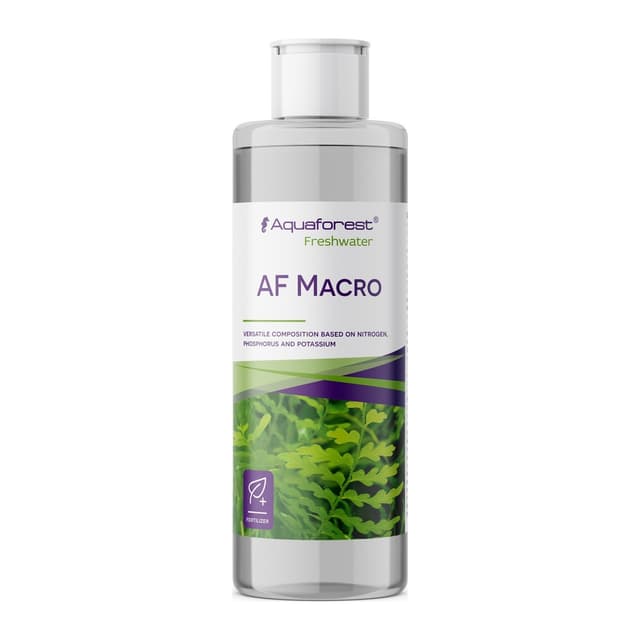
Aquaforest Macro is a concentrated macronutrient fertiliser (nitrogen, phosphorus, potassium, magnesium): the dose is 5 ml per 100 l twice a week, recommended together with Aquaforest Micro and not to be combined with other macronutrient products. N Boost and PO4 Boost are in the range separately if you want to adjust a single element precisely. Aquaforest Red Boost supports the colour of red plants.
2Hr Aquarist APT Complete is an all-in-one liquid fertiliser: the dose is 5 ml per 100 l four times a week, or 3 ml daily. For new tanks with aquasoil and for aquariums with more fish the manufacturer recommends APT Zero, and APT EI is designed for the Estimative Index method, with a dose of 5 ml per 100 l three times a week. These products differ, so always follow the dose on your own pack.
4. Dosing and overdosing
The dose is always written on the pack and the product page. For a beginner it makes sense to start with the lower recommended dose on the pack and increase it only when the plants need it. Do not double the dose if plants look pale: the cause can also be light or CO2.
Too much fertiliser together with strong light gives algae an opening. Algae grow when there are more nutrients than plants can use. To avoid this, change part of the water weekly, do not add fertiliser between water changes without need, and do not add several products containing macronutrients at once.
5. Fertiliser, light and CO2
Fertiliser, light and CO2 work together. In a tank with low light and no CO2, plants grow slowly and need few nutrients, so a smaller dose is often enough. In a tank with high light and CO2, plants grow fast and consume more, so fertilising is more regular.
When you change one factor, watch the other two. If you raise the light, think about CO2 and fertiliser too. If you add CO2, make sure there are enough nutrients. To follow the changes, make them one at a time and note what changed and when.
A good habit is to keep a simple notebook: write down the fertiliser name, the dose and the water change date. After a couple of weeks you can see whether plant growth and leaf colour have improved, and you can adjust the dose calmly.
Liquid fertiliser comparison (from manufacturer descriptions)
| Product | Contains | Suits | Dose on pack |
|---|---|---|---|
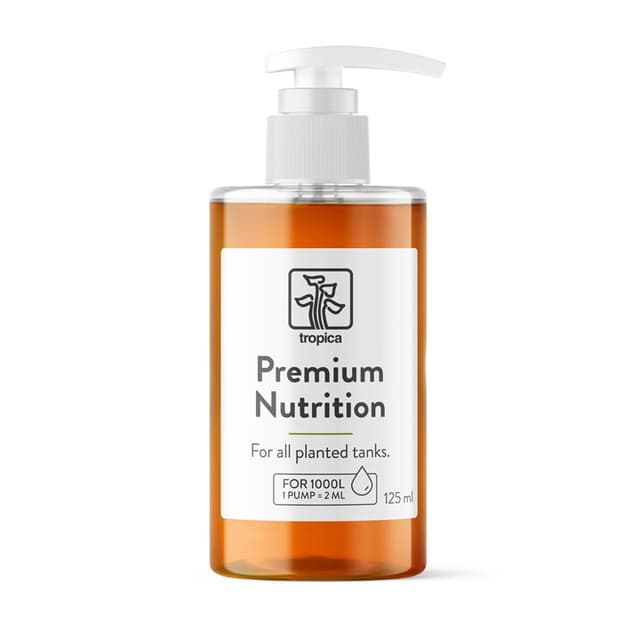
| Tropica Premium Nutrition | Iron, magnesium, micronutrients; no N or P | Many fish, few plants | 6 ml / 50 l weekly |
| Tropica Specialised Nutrition | N and P, iron, magnesium, micronutrients | Many fast plants | 6 ml / 50 l weekly |
| Tropica Carbon Nutrition | Liquid carbon | Plants, helps prevent algae | 4 ml / 100 l daily |
| Aquaforest Macro | N, P, K, Mg | With Aquaforest Micro | 5 ml / 100 l twice weekly |
| 2Hr APT Complete | All-in-one fertiliser | Planted aquariums | 5 ml / 100 l 4× weekly |
| 2Hr APT Zero | All-in-one fertiliser | New aquasoil, more fish | 5 ml / 100 l 4× weekly |
Checklist
- Decide whether you need macro or micro fertiliser
- Choose by the number of plants in the tank
- Follow the dose on the pack
- Start with the lower dose
- Change part of the water weekly
- Do not combine several macro fertilisers
- Keep an eye on light and CO2
- Reduce the dose when algae appear
Products for this guide
from€6.99
Unit price: €55.92 / l

from€7.99
Unit price: €63.92 / l

from€7.99
Unit price: €63.92 / l
from€7.90
Unit price: €31.60 / l

from€9.99
Unit price: €99.90 / l

from€9.99
Unit price: €99.90 / l
Frequently asked questions
Is liquid fertiliser always necessary?
No. In a tank with many fish and few plants the plants may get enough nutrients from fish waste, but fast-growing plants need extra.
What is the difference between macro and micro fertiliser?
Macro fertiliser provides nitrogen, phosphorus and potassium; micro fertiliser provides iron and other elements needed in small amounts.
Does more fertiliser make plants grow faster?
Not necessarily. If light or CO2 is the limiting factor, plants cannot use the extra nutrients and the surplus favours algae.