1. Why test the water in a planted tank
Plants often show a problem only after it has happened: leaves turn yellow, algae appears or growth stops. A water test gives you the answer earlier. By measuring a few values you can tell whether the plants have enough nutrients and whether the water is safe for the fish.
A beginner does not need to measure everything at once. Start with nitrate and phosphate, add carbonate hardness (KH) and general hardness (GH), and if you use a CO2 system, the CO2 level as well. Add the rest when you need it.
2. Nitrate and phosphate: plant food
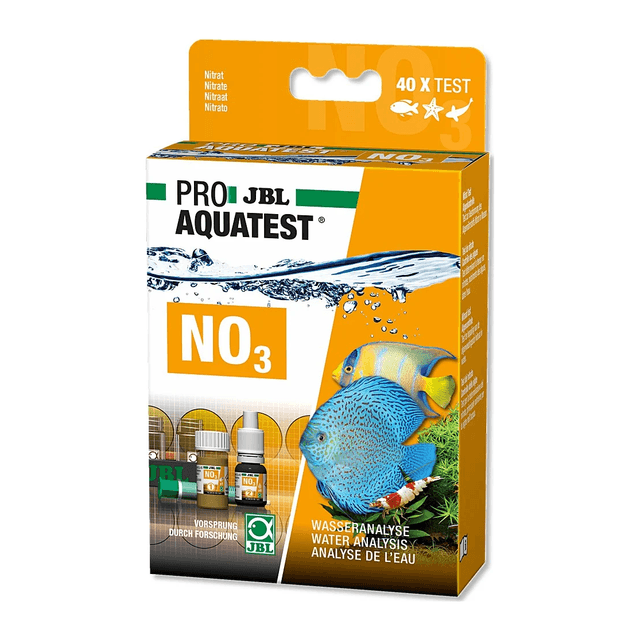
Nitrate (NO3) comes from fish waste and is the main nitrogen source for plants. According to the manufacturer, JBL Test PRO NO3 matters especially when the tank is fertilised: too much nitrate can be dangerous to fish, and plants do well with neither too little nor too much.
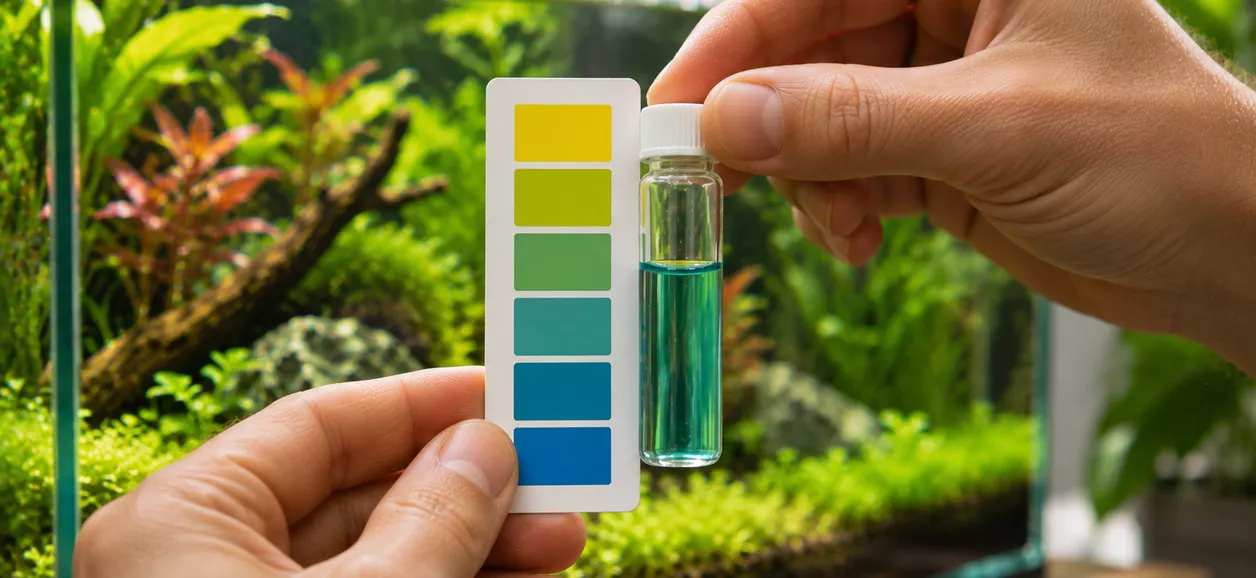
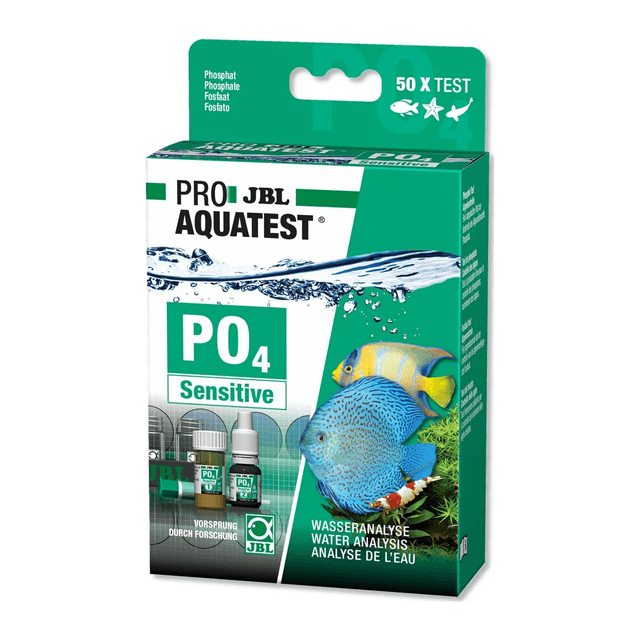
Phosphate (PO4) is the second nutrient. According to the JBL Test PRO PO4 Sensitive description, the result helps you dose fertiliser so that plants get enough while excess phosphate does not feed algae. Always measure with the same test and read the colour in the same light so results stay comparable.
The trend tells you more than a single reading: if nitrate rises week after week, change more water; if it sits near zero all the time and plants turn yellow, nutrients may be missing.
3. KH, GH and pH
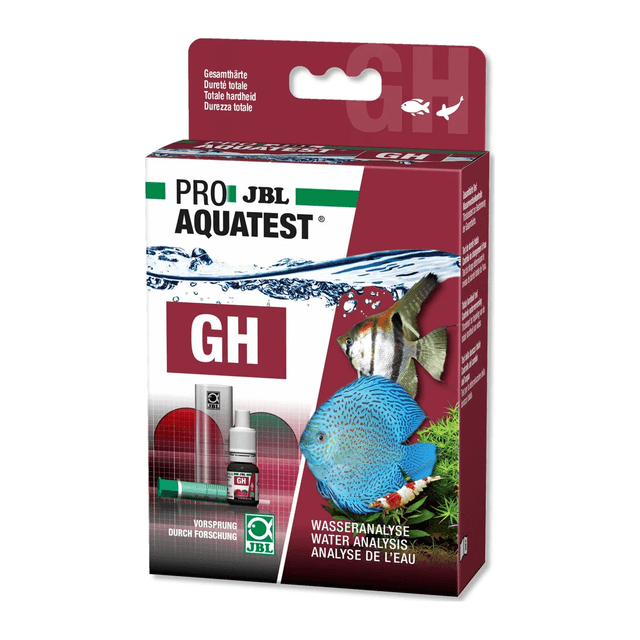
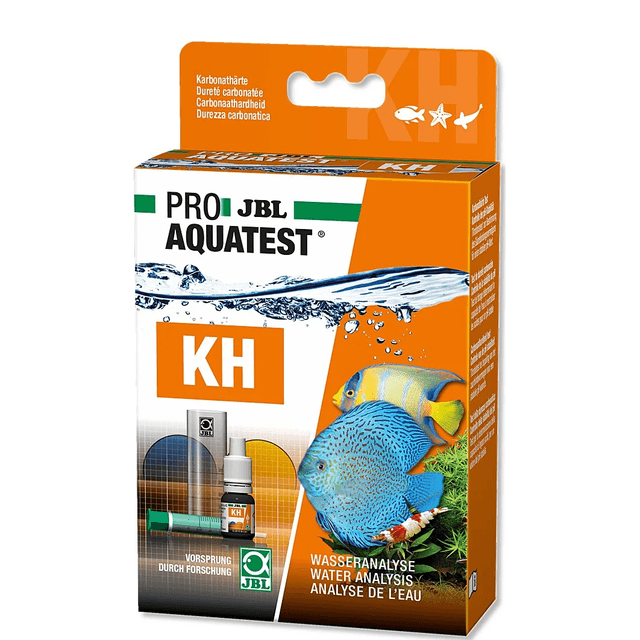
General hardness (GH) shows the amount of dissolved calcium and magnesium, while carbonate hardness (KH) shows the buffering capacity of the water, that is, how easily pH changes. According to the manufacturer, JBL Test PRO GH and KH come with a test tube, reagent, syringe and colour scale, so measuring is simple.
For plants it matters that these values stay stable. Starting from tap water, measure GH and KH once so you know what water you have. After that, you only check whether anything has shifted.
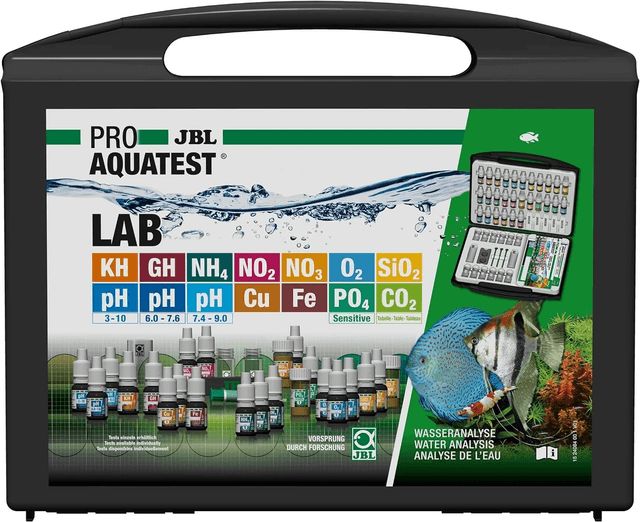
Measure pH together with KH. If you use a CO2 system, the CO2 level can be estimated from the pH and KH values: the JBL TestLab set description lists CO2 as a value calculated from pH and KH with the supplied table.
4. CO2 and ammonium
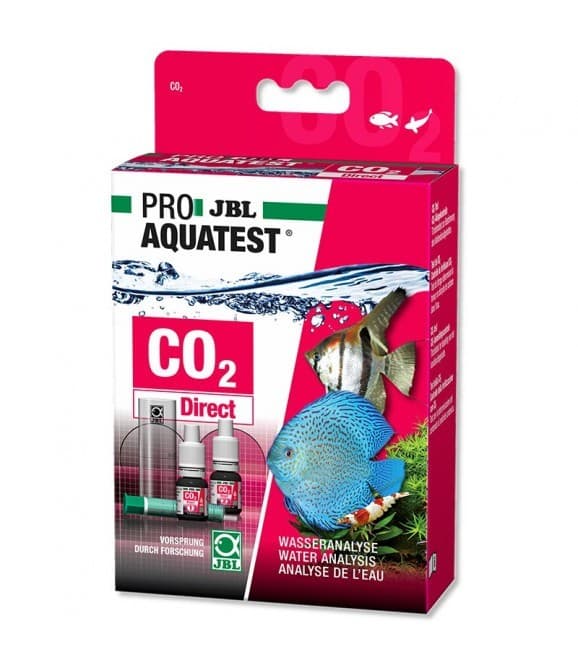
CO2 is one of the main nutrients for plants, but too much can endanger fish. JBL ProAquaTest CO2 Direct measures the carbon dioxide content directly and helps keep the level matched to stocking, light and plants. For setting it up, read the CO2 guide.
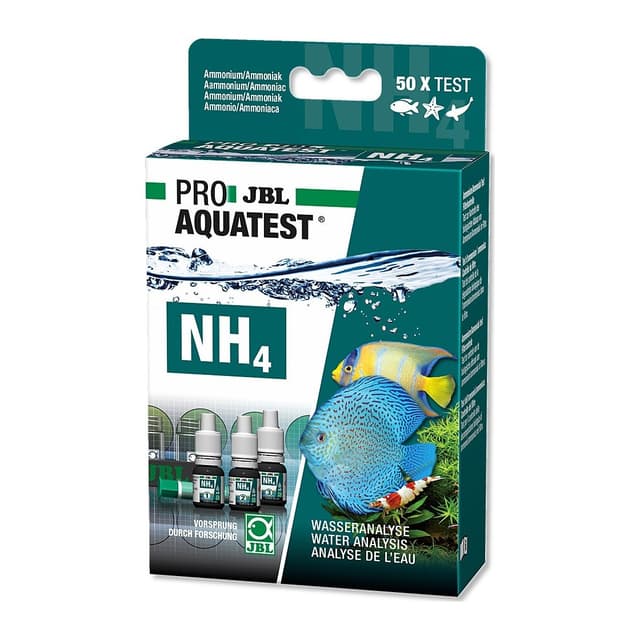
Ammonium (NH4) is worth measuring when you start a new tank and add fish. Nitrifying bacteria turn ammonia into nitrite and nitrite into nitrate; in a mature aquarium ammonium and nitrite should read zero. JBL Test PRO NH4 helps you follow this.
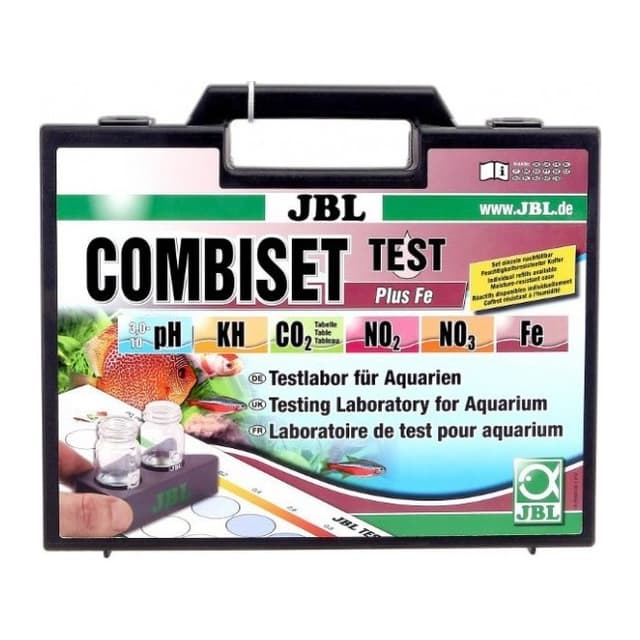
If you want just one box, look at the JBL Combi Set (pH, KH, nitrite, nitrate, iron) or JBL TestLab, which according to the manufacturer’s list covers several values at once.
5. How often to test
In a new tank test more often, for example once a week, and write the results in a notebook. In a stable aquarium once a month is usually enough, or whenever something changes: you add fish, change the fertiliser dose, adjust CO2 again or notice algae.
Test before a water change, not after it, and do not measure right after adding fertiliser. That way you see the real situation, not a momentary peak. Keep reagents cool and dark and check the expiry date, because an old reagent gives inaccurate results.
Watch the tank itself as well: if the fish behave unusually or the water is cloudy, do not wait for a test. Change some water and look into the cause afterwards.
What each test tells you and what to do
| Value | What it shows | If the result is off |
|---|---|---|
| NO3 (nitrate) | Nitrogen food for plants, end product of fish waste | High: change more water. Constantly zero: plants may starve |
| PO4 (phosphate) | Plant nutrient, excess feeds algae | High: check fertiliser dose and the water source |
| GH | Calcium and magnesium content | If it shifts: compare with tap water |
| KH | Buffering capacity, pH stability | Very low: pH can swing, especially with CO2 |
| pH | Acidity; with KH lets you estimate CO2 | Fast swings: check KH and CO2 dose |
| CO2 | Carbon source for plants | Too high: reduce the gas, it is dangerous for fish |
| NH4 / nitrite | State of the cycle and biological filter | Should be zero in a mature aquarium |
Checklist
- Start with nitrate, phosphate, KH and GH
- Always use the same test and read the colour in the same light
- Measure before a water change, not after
- Write results in a notebook and follow the trend
- With a CO2 system also measure CO2 and pH
- In a new tank test once a week
- Check the reagent expiry date
- Do not chase a number: change one thing at a time
Products for this guide
Frequently asked questions
Are tests necessary in a planted aquarium?
They are not mandatory, but they help you find problems early. A beginner is fine with nitrate, phosphate and hardness tests, plus a CO2 test if you use CO2.
What is a normal nitrate level?
It depends on fish, plants and fertilising. Follow the test’s colour scale and the manufacturer’s advice, and watch how the value changes over weeks.
Is one test set enough?
A set is a good start, but if you want to follow phosphate or CO2 more closely, a separate test makes sense in addition.
Why does the result in the same tank change during the day?
Plants use CO2 and nutrients while the light is on, and a CO2 system usually switches on and off. Always measure at the same time of day and in the same conditions, so results are comparable and you see the real trend instead of random swings.